Conversion Rate Calculator
Find out what share of your traffic actually converts. Enter your visits and conversions to get your conversion rate as a percentage instantly, with the formula explained and 2026 benchmarks by industry so you can judge the result in context.
Calculate your conversion rate
How is conversion rate calculated?
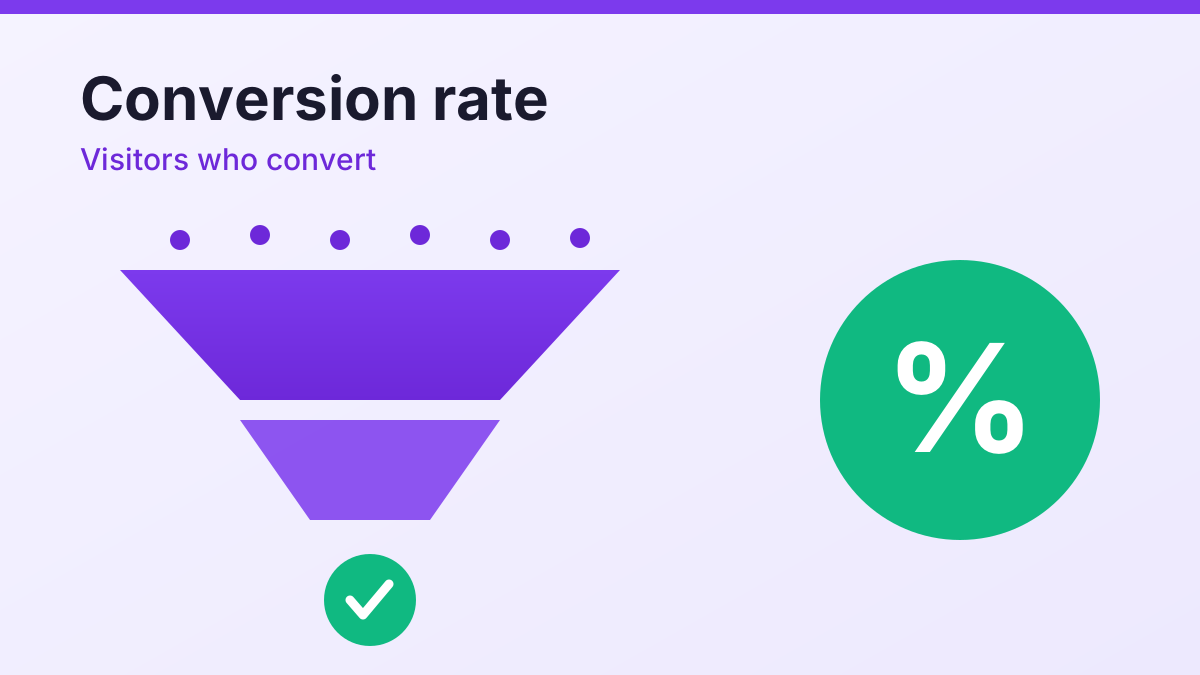
How is conversion rate calculated? Divide the number of conversions by the number of visitors, then multiply by 100. If 250 of 10,000 monthly website visits convert, the conversion rate calculation is (250 ÷ 10,000) × 100 = 2.5%.
Because the result is a percentage, you can compare a landing page that saw 500 visits against one that saw 500,000. This conversion rate calculator handles the math for sessions, visits, ad clicks, or emails sent — anywhere a visitor can take a defined action.
Conversion rate benchmarks by industry in 2026
Average conversion rates vary widely by industry and channel, so a single global number is rarely useful. These 2026 reference ranges give you context when reading your own rate.
| Industry / channel | Typical conversion rate (2026) |
|---|---|
| E-commerce (all retail) | 1.5% – 3% |
| Consumer goods & DTC | 2% – 4% |
| B2B / SaaS lead generation | 2% – 5% |
| Finance & insurance | 5% – 8% |
| Google Ads search (cross-industry avg) | ~8% (8.18% LocaliQ/WordStream 2026) |
High-intent search traffic converts far better than cold social or display audiences, so always judge your rate against the channel and industry it came from.
How to use this calculator
- Enter your visits or sessions. Add total traffic for the period. Many teams start from their monthly website visits pulled from analytics, but any consistent window works.
- Add your conversions. Enter how many visitors completed the goal. Keeping both numbers in the same window is what makes the conversion rate calculation accurate.
- Read your rate and benchmark it. The tool returns your rate as a percentage. Compare it to the 2026 benchmarks below to see how your conversion rate stacks up by industry.
Frequently asked questions
How is conversion rate calculated?
Divide conversions by total visitors and multiply by 100. For example, 120 conversions from 4,000 visits is a 3% conversion rate. That is the entire conversion rate calculation, and the calculator above does it for you in one click.
What is a good conversion rate in 2026?
For most e-commerce sites, 2%–3% is typical and anything above 4%–5% is strong. Lead-generation, finance, and high-intent search pages often run higher. Always compare against your own industry rather than a single global average.
Should I use visits or sessions?
Either works as long as you are consistent. Sessions count each visit separately, while unique visitors deduplicate people. Pick one denominator — many teams use monthly website visits — and keep it fixed so trends stay comparable over time.
How can I improve my conversion rate?
Tighten your page's message-match to the ad, reduce form friction, add trust signals, and speed up load time. Small gains compound: moving from 2% to 3% is a 50% lift in conversions from the same traffic.
Conversion rate, CTR, and CPA together
Conversion rate sits between click-through rate and cost per acquisition. CTR gets visitors to your page, conversion rate turns them into customers, and CPA tells you what each of those customers cost. Raising conversion rate lowers CPA without spending an extra dollar on media, which is why it is often the highest-leverage number a marketing team can improve.